Teresa: A Decorative Display Typeface for Unforgettable Branding
There are typefaces that whisper, and there are typefaces that command the room. Teresa is unapologetically the latter. This isn't a font you use for body copy or a polite business letter; it's a statement piece, a visual exclamation point designed for projects that demand to be remembered. For designers and creators tired of blending in, Teresa offers a distinct personality—artistic, bold, and polished—transforming ordinary headlines and logos into genuine focal points. It's the typographic equivalent of a signature accessory that defines an entire outfit.
More Than Just Letters: The Visual Power of Teresa
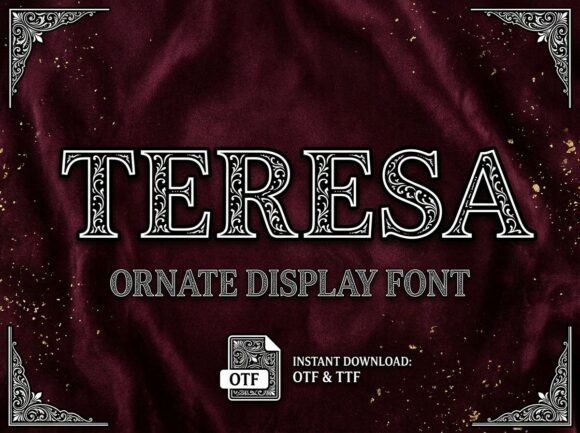
What immediately sets Teresa apart is its strong visual character. It's a premium display font that doesn't just spell words; it illustrates them. Each capital letter is crafted with unique artistic elements, giving the entire alphabet a cohesive yet dynamic energy. Think of it as a modern take on decorative typography, where every glyph feels intentional and designed for impact. This isn't about cold, geometric precision; it's about injecting personality and flair directly into your text.
The font's all-caps nature is a crucial part of its design intent. As a display typeface, its purpose is high-impact visibility. Using all uppercase letters creates a uniform, powerful block of text that reads as a single visual unit, making it perfect for moments where brevity and boldness are key. It eliminates the visual rhythm of ascenders and descenders found in lowercase, creating a more compact and forceful impression ideal for logos, headers, and packaging where space is limited and attention is scarce.
Where Teresa Truly Shines: Practical Applications
Understanding a font's personality is one thing; knowing where to deploy it is another. Teresa's versatility is its strength, allowing it to adapt across various creative and commercial contexts. Its professional finish ensures it looks polished whether printed on a luxury product or displayed on a high-resolution screen.
Branding and Identity: For a brand seeking a memorable and artistic identity, Teresa can become the cornerstone of its visual language. Imagine it as the primary logotype for a boutique skincare line, an artisan coffee roaster, or a creative agency. Its distinctiveness aids in instant brand recognition, making a logo feel bespoke and full of character.
Packaging and Product Design: On packaging, Teresa does the heavy lifting of attracting a customer's eye from a crowded shelf. It's exceptionally effective for product names, flavor labels, or edition titles. Pair it with a clean sans-serif for ingredient lists and descriptions to maintain readability while letting the headline font steal the show.
Digital Presence and Marketing: In the fast-scrolling world of social media, a bold headline font is invaluable. Use Teresa for Instagram quote graphics, YouTube thumbnails, or Facebook ad headlines to stop the scroll. On a website, it can be used strategically for hero section text, section headers, or promotional banners, adding a layer of creative flair without compromising the site's overall usability.
Editorial and Print Projects: The font has a place in editorial design for magazine covers, feature article titles, and pull quotes. It brings a contemporary, artistic edge to layouts. For print materials like posters, event invitations, or business cards, Teresa adds a tactile quality, making the physical item feel more considered and premium.
Integrating a Creative Font into Your Workflow
Adopting a font with such a strong personality requires a thoughtful approach. The goal is to harness its energy without overwhelming your audience. Here’s how to make it work effectively for you.
Font Pairing is Key: Teresa will rarely, if ever, stand alone in a full design. Its best partner is often a neutral, highly legible font. A classic sans-serif like Helvetica, Futura, or a modern grotesque provides a clean, professional counterbalance. For a different mood, a simple serif font can create an interesting contrast. Use Teresa for the main headline, and the paired font for subheadings and body text. This creates a clear visual hierarchy that guides the viewer's eye.
Context and Readability: Always consider the viewing environment. A font that looks stunning on a poster in your studio might become illegible when scaled down on a mobile website. Test Teresa at the actual sizes it will be used. As an all-caps display font, it is not suited for long paragraphs or small text blocks, where it would severely hinder readability. Its power lies in short, impactful bursts.
Review the Included Files: The package typically includes both OTF and TTF files. The OTF (OpenType Font) is the professional standard, offering advanced typographic features and compatibility with design software like Adobe Creative Suite. The TTF (TrueType Font) ensures universal compatibility across operating systems and other applications, which is crucial if you're creating files for clients or for use in word processors and basic design tools.
Licensing for Commercial Use: Before finalizing any project, especially one for commercial sale, it's imperative to review the font's licensing terms. A standard license often covers most uses, but if you're creating merchandise for sale, embedding the font in software, or using it in a large-scale enterprise project, you may need an extended license. This is a standard and important step in professional design to ensure you have the rights to use the asset as intended.
Elevating Your Visual Communication
Ultimately, a typeface like Teresa is a tool for enhanced visual communication. It helps solve specific design challenges: how to make a brand feel more artistic, how to ensure a product name pops, or how to give a social media graphic the personality it needs to engage an audience. By improving the visual consistency of your headlines and logos, you strengthen overall brand recognition. A consistent, distinctive typographic choice becomes part of your brand's signature, something your audience learns to associate with your unique style.
Choosing the right creative font is about matching the tool to the task. If your project calls for subtlety and extensive text, a traditional serif or sans-serif is the answer. But when the brief is to be bold, artistic, and unforgettable, a decorative display font like Teresa provides the visual vocabulary to do exactly that. It’s an investment in a design asset that can transform the ordinary into the extraordinary, one headline at a time.